For Basques, pilota is more than just a game
Pilota is a game that creates community. Traditionally, the frontoia (handball court) is in the center of town and acts as a gathering place. Basques come to the frontoia not only to play, watch, and even bet on pilota games, but to enjoy communal meals, hold herri kirolak (rural sports) competitions, and watch dance performances. Just like in Basque communities around the world, the Festival built a frontoia to be the center of the Basque program.
-

Frontoia in Mundaka, Bizkaia, with children playing. Photo by Tyler Nelson, Ralph Rinzler Folklife Archives -

Frontoia as a backdrop to the farmers’ market. Photo by Mary Linn, Ralph Rinzler Folklife Archives
-

Frontoia as main stage and center of the Basque program. Photo by Joe Furgal, Ralph Rinzler Folklife Archives -

A Basque American dance group performing and teaching audience members the steps. Photo by Josh Weilepp, Ralph Rinzler Folklife Archives -

A herri kirolak (rural sports) athlete demonstrates tug of war. Photo by Joe Furgal, Ralph Rinzler Folklife Archives -

Joaldunak from Nafarroa perform a pre-Christian carnaval dance on the frontoia. Photo by Joe Furgal, Ralph Rinzler Folklife Archives
There are many variations of pilota, but the main three styles are esku pilota (bare hand), paleta (with a paddle), and the high-speed jai alai (with a curved basket). To teach about these styles, jai alai gold medalist Juanan Compañon “Konpa” and Xabier Berrueta from the North American Basque Organization’s Pilota Club led demonstrations. The fast pace of the game and Konpa and Berrueta’s infectious love of the sport had visitors flocking to learn more.
-

Esku pilota (played with a bare hand). Photo by Robert Friedman, Ralph Rinzler Folklife Archives -

Paleta (played with a paddle). Photo by Josh Weilepp, Ralph Rinzler Folklife Archives -

Jai alai (played with a curved basket). Photo by Joe Furgal, Ralph Rinzler Folklife Archives
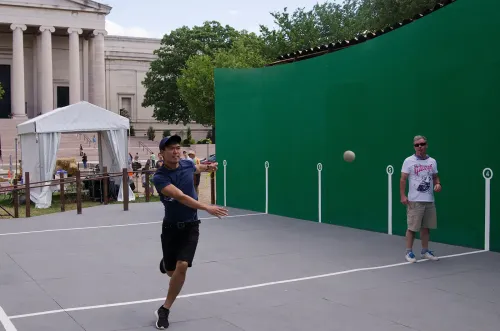
While the frontoia hosted an array of cultural performances, the most common sight on the court was a game of pilota. Whenever there was a moment of downtime and a spare ball, someone would strike up a game of esku pilota. Not only did it bring together Basque and Basque American athletes, it brought together the entire Festival. One memorable afternoon, some of the participants decided to teach Festival staff how to play. Our shouts of joy and sometimes frustration drew in others who watched and cheered us on. Playing pilota in that moment created a community brought together by the love of the game.
-
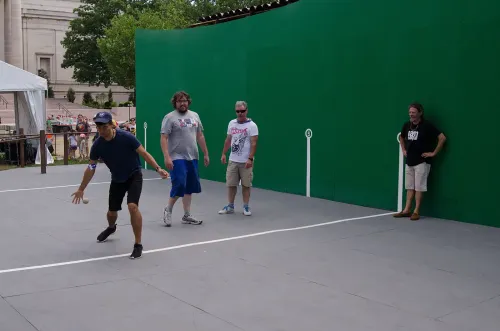
While waiting to take a group photo, several Basque participants join in a friendly round of pilota, and Folklife video producer Albert Tong improved his pitch. Photos by Josh Weilepp, Ralph Rinzler Folklife Archives -