

The Q’eswachaka rope bridge in the Cusco highlands of Peru—rebuilt hundreds of times over hundreds of years by the local communities—was reimagined and rebuilt on the National Mall in 2015. It became both the visual anchor and community center of Perú: Pachamama.
Through time and space, the bridge created a Festival community
“We didn’t plan for this to be the centerpiece of the Festival. It just came to us while we were doing fieldwork. We went down to Cusco and were looking at tradition and change. And here we found this bridge… While it is not used anymore by the alpacas for transportation, people use it as a footpath. But mainly they keep it for its symbolic value. Rebuilding the bridge every year and practicing this ancient knowledge gives them the strength to live with dignity.”
—Olivia Cadaval, program curator
Gallery
-
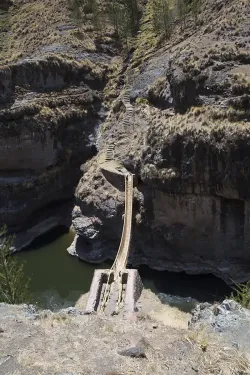
Q’eswachaka bridge in Peru. Photo by Cristina Díaz-Carrera, Ralph Rinzler Folklife Archives -
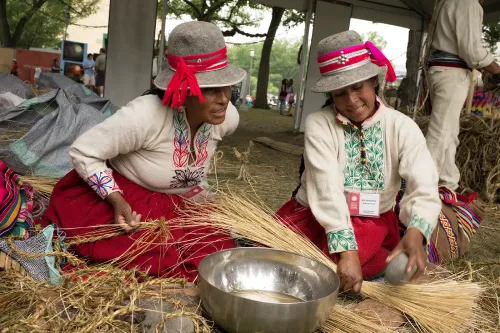
Rope braiders Alejandrina de Mamani and Alejandrina Puma pound the gathered and dried grasses prior to twisting them into rope. Photo by Vivianne Peckham, Ralph Rinzler Folklife Archives -
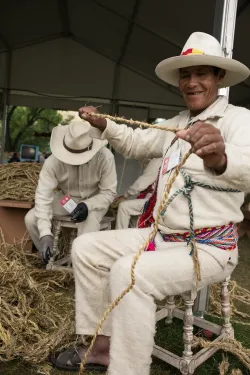
The slow process of creating rope continues with the bridge builders. Photo by Vivianne Peckham, Ralph Rinzler Folklife Archives -
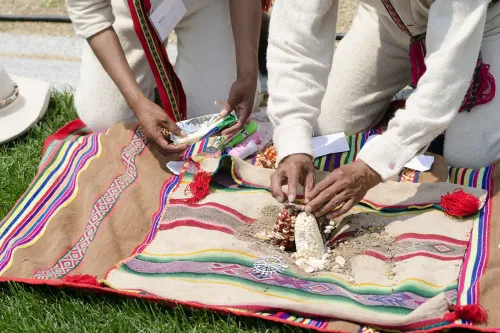
Ritual offerings are made throughout the bridge building process. Photo by Josh Weilepp, Ralph Rinzler Folklife Archives
The handwoven rope bridge has brought together the four indigenous farming communities in the area for centuries. Each has a specialty: the engineers come from one community; the grasses for the rope are gathered and processed by another. There is special expertise in braiding and tying the ropes, as well as stringing them across the canyon.
At each stage, the spiritual leader makes offerings that include coca leaves, potatoes, and corn. When the bridge is finished, the community gives thanks, celebrates with music, special foods, and a corn beverage. These practices were observed on the Mall with only slight modification.
“The whole experience on the Mall was very moving. The Quechua builders understood that being at the Festival was about showing the process. When it came time to throw the ropes between our mountains (two shipping containers) and over our river (the space between), they needed some help. They turned to the Afro Peruvians. These are communities that didn’t know each other, hadn’t ever met, and all of a sudden they are working together. Musician Miguel Ballumbrosio said it was a highlight of his time at the Festival. At the Mall, the bridge itself created a community!”
—Olivia Cadaval, program curator
Gallery
-

A unique, multi-cultural Peruvian community came together during the 2015 Festival. Photo by Josh Weilepp, Ralph Rinzler Folklife Archives -

When the time came to hoist the heavy rope up from the ground, members of the Afro-Peruvian musical group Tutuma joined the Quechua bridge builders to add their muscle. Photo by Josh Weilepp, Ralph Rinzler Folklife Archives -
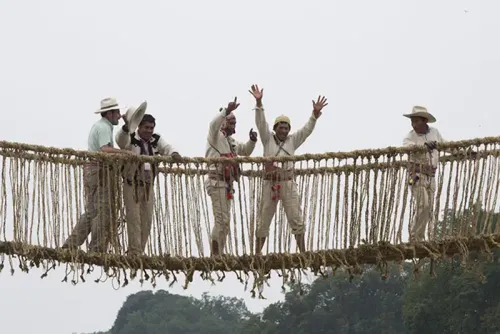
The Quechua builders celebrate completion of the bridge, made in the tradition of the Q’eswachaka bridge in Peru. Photo by Francisco Guerra, Ralph Rinzler Folklife Archives

