
From April through August 2019, a series of collaboratively produced programs was presented at sites around the city, including the National Mall.
Browse the list of events in chronological order below. Click on the images for photo slideshows and the “more” links for related blog posts.
-
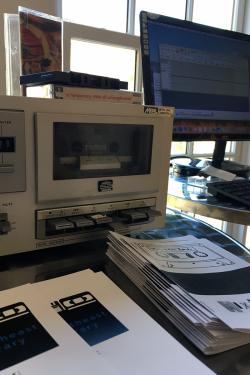
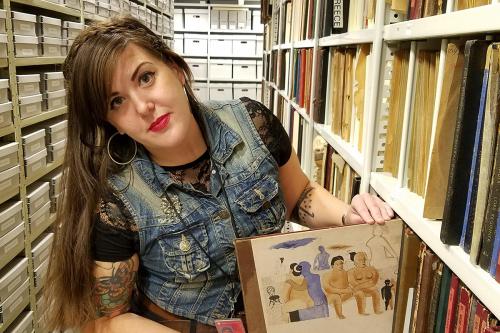 Nichole Procopenko in the Ralph Rinzler Folklife Archives and Collections
Photo by Cecilia Peterson
Smithsonian Year of Music Listening PartyFor a discussion entitled “That little piggie went to market, so they’re kicking out everyone,” Nichole Procopenko led a guided listening of selected music tracks by D.C. artists that respond to the changes transforming the city’s neighborhoods and communities. Procopenko was the co-curator of the D.C. Music programming at the Folklife Festival, and she is the archivist at Dischord Records.
-
-
-
1 / 7Image courtesy of National Postal Museum
-
2 / 7The Charles Sumner School Museum and Archives organized a display showing the class photo of Marvin Gaye when he was a student at Randall Junior High School in D.C. Other items on display this day included photos and memorabilia highlighting the role of Washington’s public schools in cultivating the city’s rich culture and arts.Photo by Sojin Kim
-
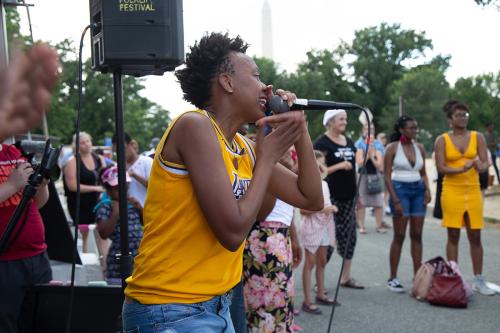
3 / 7The Woodrow Wilson High School Poetry Club performed poetry exploring themes specific to Washington and expressive of experiences shared by communities in urban neighborhoods around the country.Photo by Nichole Procopenko
-
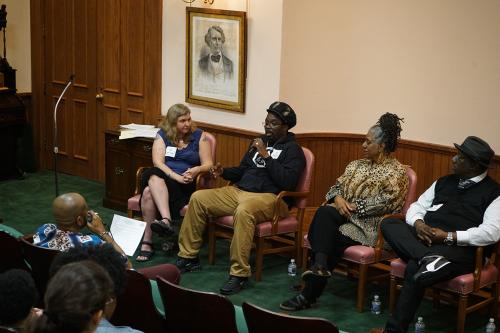
4 / 7Artist Head-Roc organized a discussion among D.C.-based artists Elise Bryant (DC Labor Chorus and the Labor Heritage Foundation), Anthony Fields (hip-hop musician, BKA Dimensions of The Package, A.R.K., Infinite Loop), Raj Lidj (funk/go-go musician and creator of Reg’go), and Katy Otto (punk musician and activist, Trophy Wife).Photo by Nichole Procopenko
-
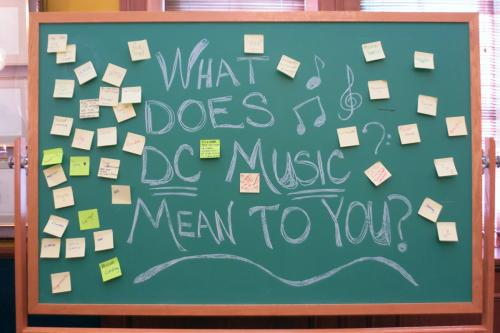
5 / 7Visitors were prompted to answer the question: what does D.C. music mean to you?Photo by Sojin Kim
-
6 / 7The band HDavid performed a tribute to Marvin Gaye.Photo by Nichole Procopenko
-
7 / 7At the National Postal Museum, DJ RBI spun music honoring Marvin Gaye’s legacy, and the Smooth & EZ Hand Dance Institute helped visitors find their groove.Photo by Nichole Procopenko
Click image to view slideshow
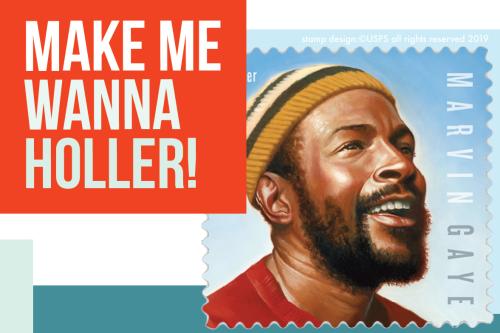
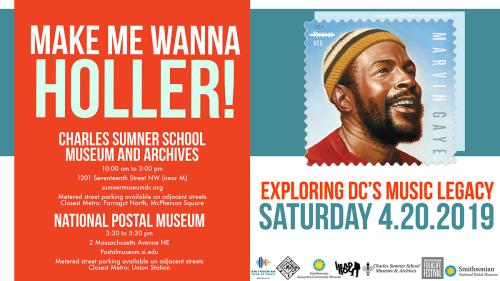
Make Me Wanna Holler: Exploring DC’s Music LegacyPerformances, panel discussion, open house, family activities, and dance party celebrating D.C. music. Produced in conjunction with the Charles Sumner School Museum and Archivesʼ National Poetry Month Open House, Chocolate City Rocks, the Anacostia Community Museumʼs A Right to the City exhibition, and the National Postal Museumʼs celebration of the US Postal Serviceʼs new Marvin Gaye stamp.
-
-




-
-
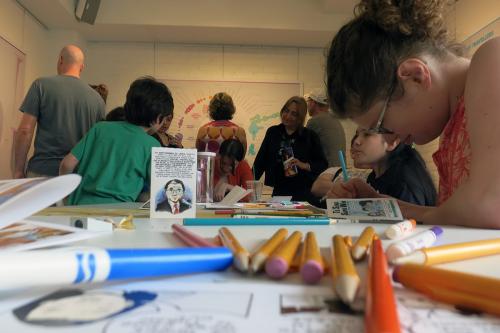
1 / 4Zine and comic workshop at Lost Origins GalleryPhoto by Sojin Kim
-
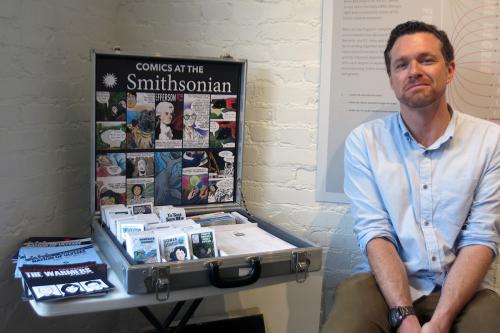
2 / 4Artist/instructor Evan Keeling shared examples of his comics about D.C. bands as well as the work he does for Smithsonian programs.Photo by Sojin Kim
-
3 / 4Flyer for a performance by Fugazi at the 2000 Smithsonian Folklife FestivalPhoto courtesy of Dischord Records
-
4 / 4Poster design by Matthew Curry
Click image to view slideshow
There’s a Story in Everything: Zinemaking & Comic WorkshopSmithsonian illustrator and comic artist Evan Keeling led a zine-making workshop as part of the gallery’s exhibition Action. Reaction. Action: Visualizing Fugazi. The exhibition explored the impact of D.C. punk band Fugazi as musicians and activists, featuring flyers, correspondence, fanzines, and data visualizations by Carni Clirs.
-
-


-
-
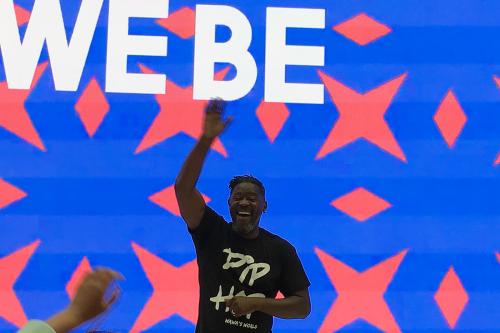
1 / 3During the session, WAWA demonstrated his style of “Dip Hop,” a performance genre he describes as “hip hop through deaf eyes.”Photo by Sojin Kim
-
2 / 3WAWA and DJ SupaLee at the Smithsonian Folklife Festival officePhoto by Xueying Chang, Ralph Rinzler Folklife Archives
-
3 / 3Wytold and Christylez Bacon at Apple Carnegie LibraryPhoto by Sojin Kim
Click image to view slideshow
Storymakers FestivalAs part of the opening month festival that kicked off D.C.’s new Apple Carnegie Library, we presented two programs:
Music and Deaf Culture—Local hip-hop artist WAWA and DJ SupaLee performed and addressed how music in D/deaf culture is interpreted, engaged, composed, and performed.
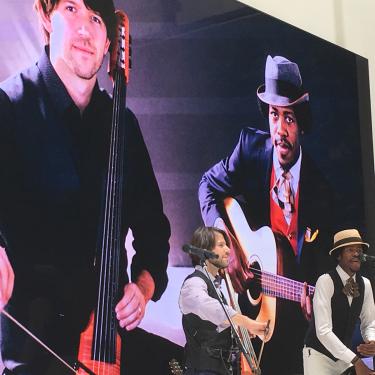
Hip-Hop Meets Electric Cello—Progressive hip-hop artist Christylez Bacon and classically trained cellist Wytold demonstrated how storytelling and collaboration are fundamental to their artistic practices.
-
-

-
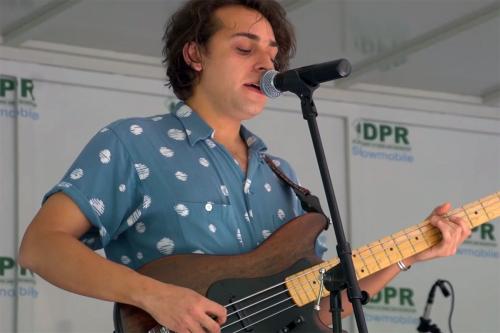
Richard Howard is the bass player for Cigarette. Still from video by Folklife video team
Downtown DC LiveThe Festival presented two mid-day concerts for the summer series organized by the Downtown BID.
TK Echo consists of D.C. punk veterans Josh Blair (drums), Fiona Griffin (keyboards, vocals), Aaron Leitko (bass), and Chris Richards (guitar, vocals), who have been playing together since 2016.
Cigarette is a dreamy slow-core band that formed in 2010 and is comprised of members Drew Hagelin (percussion), Evan Napala (guitar, vocals), Richard Howard (bass, vocals), and Jonathan Howard (guitar, vocals).
-
-
-
1 / 16Globe Collection and Press at MICAPhoto by Sonya Pencheva, Ralph Rinzler Folklife Archives
-
2 / 16Anatomy of a “PA Tape”—Nico “The GoGo-ologist” Hobson took listeners on a guided audio tour through a historical recording of a live go-go show.Photo by Sonya Pencheva, Ralph Rinzler Folklife Archives
-
3 / 16DC Public Library session with OnRaé LaTeal, who led visitors in musical games from her Black Girls Handgames Project.Photo by Kerri Redding, Ralph Rinzler Folklife Archives
-
4 / 16DC Public Library session with Malik DOPE Drummer, who invited the public to join him in percussion activities.Photo by Sonya Pencheva, Ralph Rinzler Folklife Archives
-
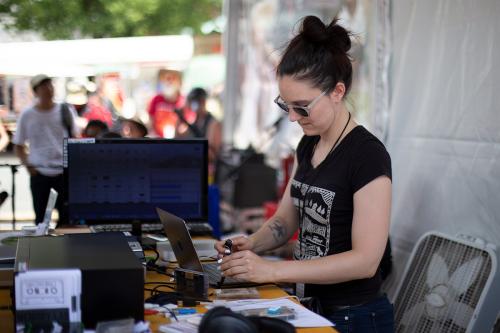
5 / 16DC Public Library staff shared information about the preservation support they offer the public. Visitors were invited to bring old cassette tapes, which they could digitize on the spot.Photo by Xueying Chang, Ralph Rinzler Folklife Archives
-
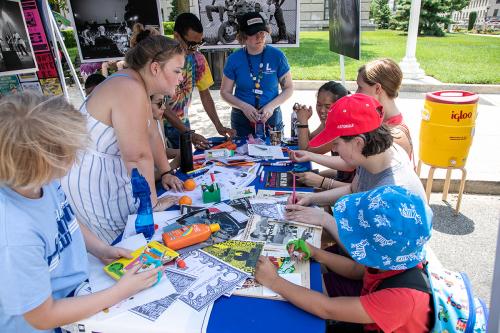
6 / 16In this flyer making activity, the DC Public Library used show flyers from their Punk Archive as examples and inspiration.Photo by Michael Barnes, Ralph Rinzler Folklife Archives
-
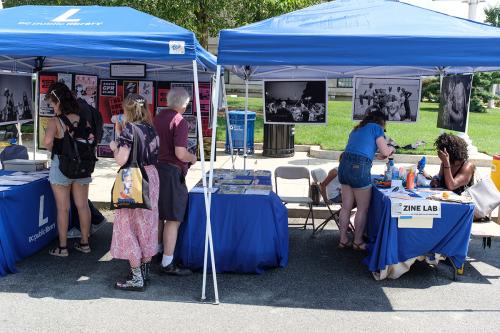
7 / 16The DC Public Library’s display featured flyers and photos from their Punk and Go-Go Archives.Photo by Josh Weilepp, Ralph Rinzler Folklife Archives
-
8 / 16Pop-up music card activity with the Anacostia Community MuseumPhoto by Sonya Pencheva, Ralph Rinzler Folklife Archives
-
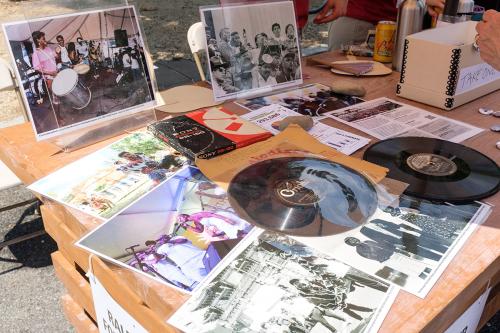
9 / 16Staff from the Ralph Rinzler Folklife Archives and Collections shared examples of different recording formats they preserve as well as photographs of past Folklife Festival performances by D.C. artists.Photo by Josh Weilepp, Ralph Rinzler Folklife Archives
-
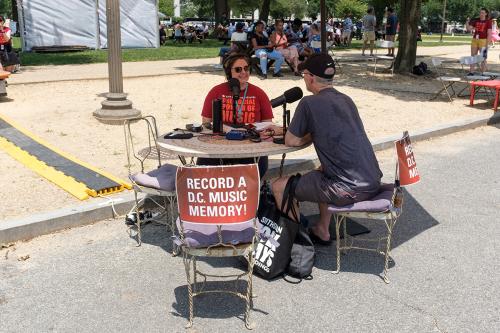
10 / 16Meredith Holmgren, a curator at the Center for Folklife and Cultural Heritage, interviews a visitor about his D.C. music experiences. The Festival partnered with the DC Oral History Collaborative to record a series of short “D.C. Music Memories.”Photo by Josh Weilepp, Ralph Rinzler Folklife Archives
-
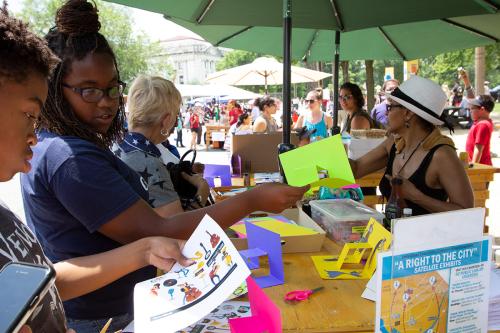
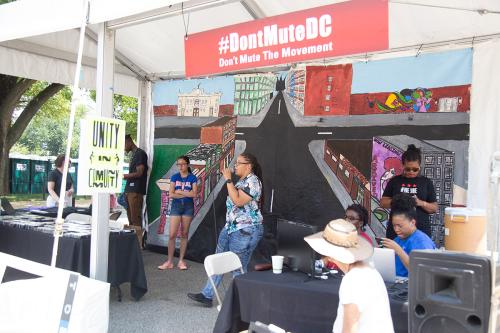
11 / 16Activists involved in the #DontMuteDC mobilization shared their experiences and concerns about gentrification, local community life, and go-go music.Photo by Kerri Redding, Ralph Rinzler Folklife Archives
-
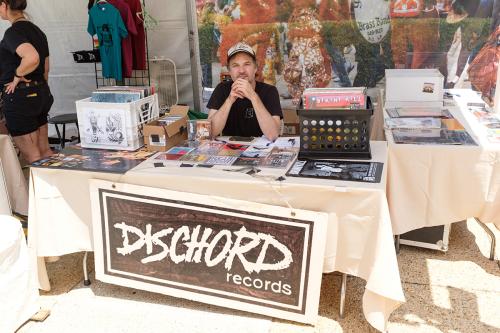
12 / 16Aaron Leitko from Dischord Records staffed a table in the Festival’s Local Record Market.Photo by Josh Weilepp, Ralph Rinzler Folklife Archives
-
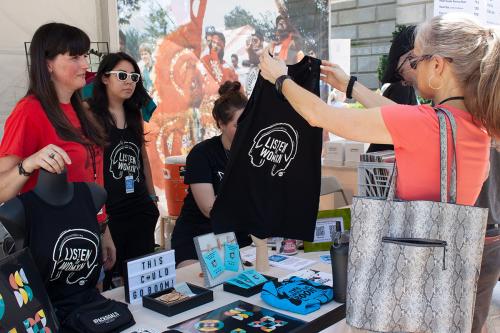
13 / 16Ara Casey, Selena Benally, and Maya Renfro from This Could Go Boom! shared information about their label’s products and programs in the Festival’s Local Record Market.Photo by Sonya Pencheva, Ralph Rinzler Folklife Archives
-
14 / 16Crown Vic and Area Woman’s Weird World Record Party provided the soundtrack for the Preservation Pop-Up.Photo by Josh Weilepp, Ralph Rinzler Folklife Archives
-
15 / 16The DC Bluegrass Union organized a music jam.Photo by Sonya Pencheva, Ralph Rinzler Folklife Archives
-
16 / 16Conga players “Smoke” Dews and Keith “Sauce” Robinson and djembe player Agyei Edwards performed with an all-star lineup of musicians for #DontMuteDC’s Royal Pocket Tour presentation celebrating go-go music’s signature rhythms.Photo by Sonya Pencheva, Ralph Rinzler Folklife Archives
Click image to view slideshow
D.C. Music Preservation Pop-UpThis day of activities and performances extended the 2019 Smithsonian Folklife Festival’s theme of the “social power of music” by featuring formal and grassroots efforts to preserve the history and legacies of D.C.’s unique and original music cultures.
Click the link below for a full list of participating organizations.
-
-
DC Public Library Punk & Go-Go Archives
In support of its mission to document local history and culture, the DC Public Library Punk and Go-Go Archives collect and preserve materials that capture our city’s amazing music. The local community contributes to this effort by donating collections, attending library music programs and performances, and volunteering to organize collections. At the Festival, the library team demonstrated their audio digitization and Memory Lab; engaged the public in making zines, journals, and buttons; provided punk rock-themed story time for young visitors; presented workshops by Malik DOPE Drummer, OnRaé LaTeal (Black Girls Handgames Project), and Nico “the GoGo-ologist” Hobson (GoWin Media).Globe Collection and Press at MICA
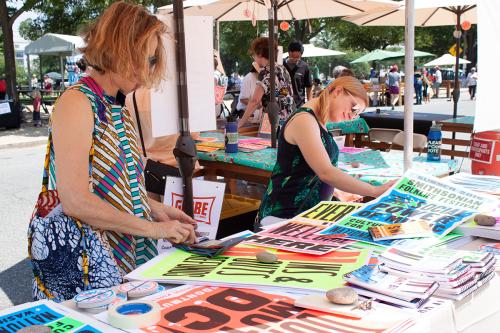
Globe Poster Printing Corporation, historically one of the nation’s largest showcard printers, has been telling the story of American music and entertainment through bright and iconic posters since 1929. For decades, these iconic posters promoted both national acts and homegrown shows on the walls and posts of D.C. streets. At the Festival, visitors browsed examples from their historic collection, reminisced about the shows they had attended, and took home postcard-size posters that Globe Collection and Press at MICA printed on site.Anacostia Community Museum
For over fifty years, the Smithsonian’s Anacostia Community Museum has engaged local communities in documentation projects, exhibitions, and programs. Festival visitors learned about the current Off-Site and In the City initiative as well as past research on D.C. school music programs, Banding Together: School Bands as Instruments of Opportunity. Local artist Alma Robinson provided music-themed hands-on activities making banjos, drums, and pop-up cards.Mayor’s Office on African American Affairs
This division of the D.C. Mayor’s office engages the diverse African American communities of the city through advocacy, capacity building, and community engagement. The office was created to highlight the rich cultural identity as well as focus its efforts in the areas of housing, health, education, employment, social services, public safety, and expanding business opportunities for African Americans in Washington, D.C.D.C. Office of Cable Television, Film, Music, and Entertainment
This office produces and broadcasts programming for the city’s public, educational, and government access cable channels and digital radio station; regulates the D.C.’s cable television service providers; provides customer service for cable subscribers; and supports a sustainable creative economy and labor market in the District of Columbia. Partnering with Georgetown University in 2019, the office launched the first-ever D.C. Music Census, which seeks to gather information that will reveal challenges and opportunities and inform the growth of the local music ecosystem.National Park Service
Staff from the Cultural Resources and Natural Resource Stewardship and Science divisions shared information about their research and programming initiatives, which includes music-related topics such as the popular Summer in the Parks, which was established in 1968 to 1976 and directly contributed to local music scenes—providing performing opportunities for young go-go and punk artists.Ralph Rinzler Folklife Archives
The Rinzler Archives of the Smithsonian’s Center for Folklife and Cultural Heritage contains thousands of audio recordings, photos, and moving images documenting D.C. local culture and communities, including over fifty years of Smithsonian Folklife Festival performances. Visitors learned about these resources and how to access them. Visitors were also invited to record their own five-minute D.C. music memory—a story about the role of music in their life or a notable music experience in the city. These recordings, facilitated by the DC Oral History Collaborative, will become part of the Rinzler Archives.DC Oral History Collaborative
Established in 2016 as a partnership project of the Historical Society of Washington, DC, and HumanitiesDC, with the DC Public Library as the sponsoring agency, the DC Oral History Collaborative preserves unrecorded Washington history by making existing oral history recordings more accessible and giving residents the training and resources they need to conduct quality interviews.The Will to Adorn
The Will to Adorn: African American Dress and the Aesthetics of Identity is a multi-year collaborative research and public presentation project of the Center for Folklife and Cultural Heritage. It explores the diversity of African American identities as expressed through the cultural aesthetics and traditional arts of the body, dress, and adornment. At the Festival, the project team asked and recorded people’s responses to the question: how do you wear your love of D.C. music?Michelle Smith Performing Arts Library, University of Maryland
The music, theatre, and dance materials of this library include circulating, reference, and serial collections, consisting of books, musical scores, periodicals, as well as audio and video recordings. At the Festival, the archives featured the Washington, D.C., Punk and Indie Fanzine Collection (DCPIFC), which documents the publications created by fans and participants in local music scenes that have thrived in the area since the late 1970s.#DontMuteDC – Don’t Mute the Movement
The #DontMuteDC uprising that began with a battle over music and public space has morphed into an urgent public conversation about gentrification, culture, history, and racial disparities in education, healthcare, criminal justice, and public safety. Go-go music has given a voice to these issues and inspired many longtime Washingtonians to renew their ongoing fight to enjoy the prosperity washing over the city. Visitors talked about cultural preservation, fighting for peace and against displacement, and a more equitable city with cultural scholar Natalie Hopkinson, peace activist Ronald “Mo” Moten, hashtag creator Julien Broomfield, music producer Tone P, and Metro PCS store owner Donald Campbell.Local Record Market
Independent record labels have long been a staple of the D.C. music scene—controlling the terms and keeping local the means of producing their music. This market offered the rare opportunity to shop in person a selection of these local catalogs and meet the people behind the labels that typically operate only as mail-order retail. Participating labels: Carpark, Crooked Beat, Dischord, Electric Cowbell, Free Dirt, Lovitt, Smithsonian Folkways, and This Could Go Boom!Crow Vic and Area Woman’s Weird World Record Party
Local artists and producers Jim Thomson and Eliza Childress took visitors on a vinyl romp through a universe of varied regional music styles from ethnic classics, old-world curios, and grooves from Washington, D.C., and beyond.DC Bluegrass Union Jam
Visitors were encouraged to bring their instruments and join the DC Bluegrass Union for an open jam session D.C. has had a significant bluegrass underground since the late 1940s. Over the last two decades, it has been undergoing a renaissance, and the DC Bluegrass Union has contributed to supporting and promoting the music locally.The Royal Pocket Tour
“The pocket” is the drumbeat that survived the hellish transatlantic slave trade and continues to be used to communicate in many of the District of Columbia’s black neighborhoods. Organized by Ronald Moten and Natalie Hopkinson, three legendary go-go conga players, along with veteran musicians from seminal bands, performed a special selection celebrating black resilience and strength—400 years since the first enslaved Africans landed in Jamestown, Virginia.



-

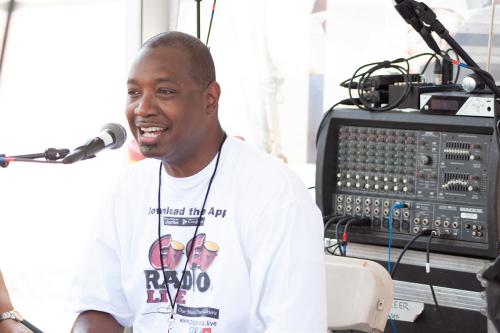
Photos by Xueying Chang, Smithsonian
First Ladies to Anthology of Booty: Women DJ Collectives in D.C.Allison Wolfe (Bratmobile, I’m in the Band podcast) organized and moderated a discussion on the past, present, and future of women’s DJ collectives in Washington, D.C. The panel featured Ebony Dumas (DJ Natty Boom, Anthology of Booty), Les Talusan (Les The DJ, Punk Soul Sisters), Maegan Wood (DJ Junebullet, Coup Sauvage & The Snips), Kristy Chavez-Fernandez (Kristy la Rat, Maracuyeah), and Kristina Gray (DJ K La Rock).
-
The event coincided with the gallery’s exhibition Frame of Mind: Punk Photos and Essays from Washington, DC, and Beyond, 1997–2017.
-
-
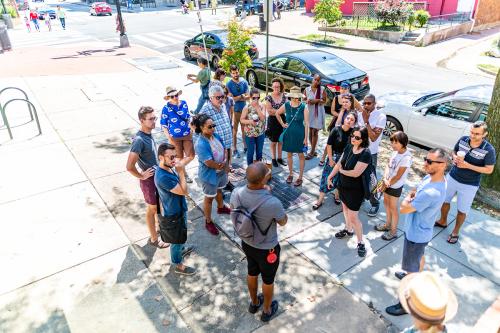
1 / 6Tim Wright of Attucks Adams Walking Tours led people on tours (“Cultivating Change: Music + Community in Mt. Pleasant”) of the neighborhood, which he had developed with Natalie Avery (Javera Group, Radio CPR).Photo by Daniel Martínez González
-
2 / 6In the gallery, cellist Janel Leppin and guitarist Anthony Pirog performed an afternoon set.Photo by Daniel Martínez González
-
3 / 6Librarian Siobhan Hagan demonstrated the work of the DC Public Library Memory Lab.Photo by Sojin Kim
-
4 / 6In Lamont Park, The OSYX (pictured), Park Snakes, and Bacchae performed live sets. Michelle Casto of DC Public Library shared resources related to their Punk and Go-Go Archives and helped visitors make spray-painted flyers.Photo by Daniel Martínez González
-
5 / 6Park SnakesPhoto by Daniel Martínez González
-
6 / 6BacchaePhoto by Daniel Martínez González
Click image to view slideshow
Mt. Pleasant: The Social Power of MusicA full day of performances and activities coincided with the closing of the Frame of Mind exhibition. The event was produced in collaboration with Lost Origins Gallery, District Bridges, and the DC Public Library Punk Archives.
-
-


-
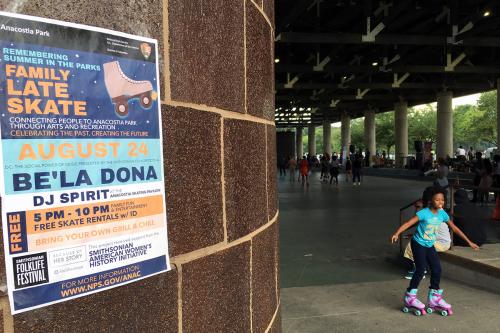
Photo by Sojin Kim
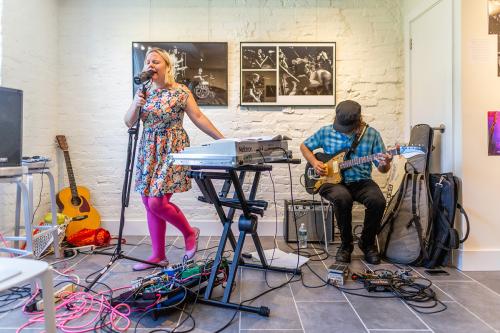
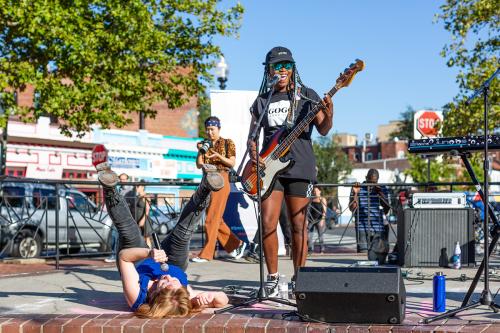
Summer in the Parks Late SkateIn the summertime, the Anacostia Park’s Late Skate events feature free skate rentals, music, live DJs, and other activities for all ages. The Festival presented a live performance by D.C.’s all-female funk fusion band Be’la Dona, and the DC Public Library Go-Go Archive was on hand to share their efforts at preserving local music history.