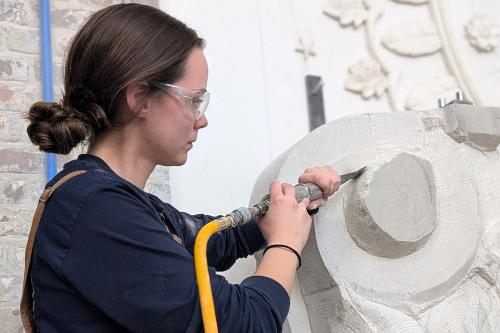
Tatum Connor, a stone carving student at the American College of the Building Arts, uses a pneumatic hammer to carve a large fountain sculpture.
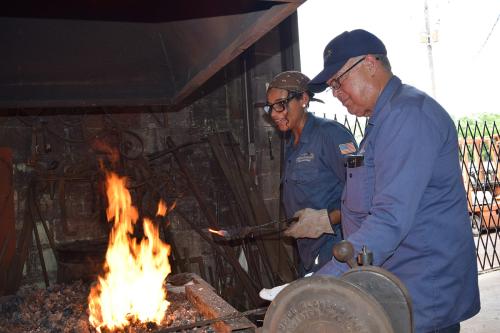
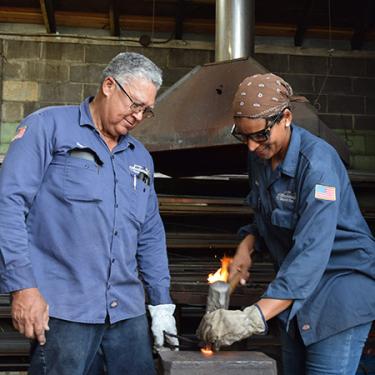
Master blacksmith Darryl Reeves and his apprentice Karina Roca heat metal in the forge at Andrew’s Welding and Blacksmith Shop in New Orleans.
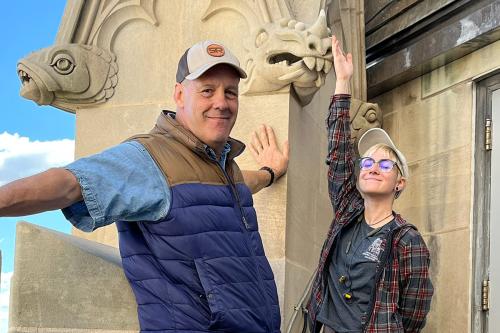
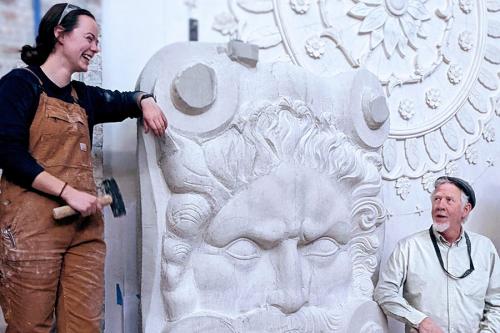
Head stone mason Joe Alonso and journeyman stone mason and carver Brianna Castelli with a grotesque that Castelli repaired at Washington National Cathedral.
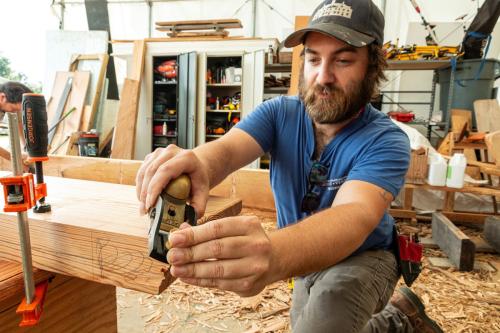
Joe Zemp, a preservation carpenter at George Washington’s Mount Vernon, is a recent carpentry graduate of the American College of the Building Arts (class of 2023) who honed his woodworking skills as an intern at Mount Vernon in 2022.

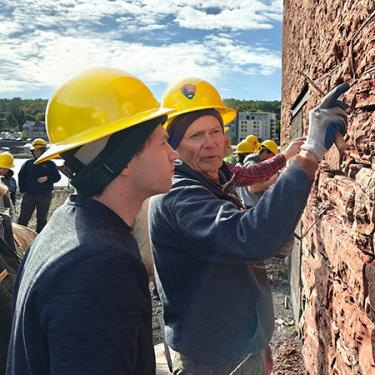
Traditional Trades Advancement Program interns with the National Park Service Historic Preservation Training Center work to measure and mark a beam for a carpentry reconstruction project on a historic structure at Manassas National Battlefield in Virginia.
Next Generation Artisans in the Traditional Building Trades
“I think it’s so important that humans create beautiful things for other humans to enjoy. It’s an expression of our human nature. It’s something that connects all of us together.”
“I love to see these young people—the kids in our community—get on in the craft. We want to keep the tradition alive.”
Skilled craftspeople in the traditional building trades play a vital role in preserving our nation’s built environment and cultural heritage. Through their knowledge and skill, their creativity and care, they help communities preserve historic places that hold memories, meaning, history, and identity. They create sustainable new architectural works of beauty and excellence that enrich us all. This crucial body of centuries-old traditional knowledge needs to be preserved and passed on to future generations.
The Next Generation Artisans program features inspiring examples of intergenerational teaching and learning in the heritage trades, highlighting the diverse voices, perspectives, and experiences of young people learning the building crafts and the master artisans dedicated to passing on their knowledge, skills, and traditions to the next generation.
Through skill demonstrations, interactive workshops, hands-on activities, and narrative stage discussions, craftspeople will share the techniques, tools, and traditions of their trades and discuss the learning process. Festival visitors will learn about a wide range of innovative traditional trades training programs and exciting opportunities for meaningful careers in the building arts.
Below, meet the extraordinary artisans—stone carvers, decorative painters, preservation carpenters, stone masons, blacksmiths, ornamental plasterers, and many others—who participated in the 2025 Festival and discover the traditional skills and values that shape their work.
Training Programs
Mentors and apprentices from these programs around the country shared their skills and stories at the Festival. Click on a program to read about their missions and what they presented on the National Mall.





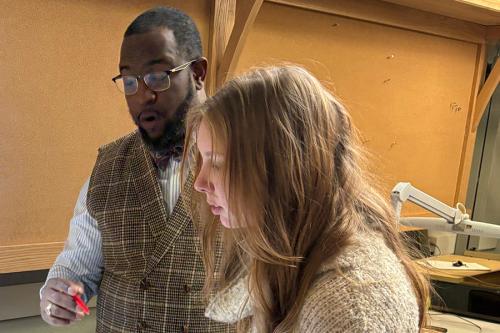
Architectural carpentry student Thomas Dezii works together with master carpenter Markus Damwerth, chair of the architectural carpentry department at the American College of the Building Arts. “It’s important for things to still be handmade because there’s inspiration and beauty in the handmade,” Dezii says.
Photo courtesy of the American College of the Building Arts
American College of the Building Arts
“I really grew to like working with my hands, and I knew I didn’t want to work some kind of desk job after high school. My parents were like, no, you still should get a degree.”
—Thomas Dezii, architectural carpentry student“I think what attracts young people to this craft is the physicality, working with your hands. We’ve strayed so far away from that, and we’re in pretty rough shape in this country because of it.”
—Joseph Kincannon, master stone carver and chair of stone carvingThe American College of the Building Arts (ACBA) in Charleston, South Carolina, integrates professional hands-on training in the traditional building trades with a liberal arts core curriculum. Its mission is to foster exceptional craftsmanship and encourage the preservation, enrichment, and understanding of the world’s architectural heritage. Craft specializations for students include architectural carpentry, blacksmithing, plastering, architectural stone carving, timber framing, and classical architecture and design.
At the Festival, stone carvers, architectural carpenters, architects, and historic preservation specialists from ACBA demonstrated their skills, shared their experiences teaching and learning the building arts, and discussed why hand craftsmanship matters to them.
Participants
Christina Rae Butler, provost, professor of historic preservation
Tatum Connor, stone carving student
Markus Damwerth, chair of architectural carpentry
Thomas Dezii, architectural carpentry student
Joseph Kincannon, chair of architectural stone carving
Phillip Smith, professor of classical architecture and design
Isabel Wood, classical architecture student
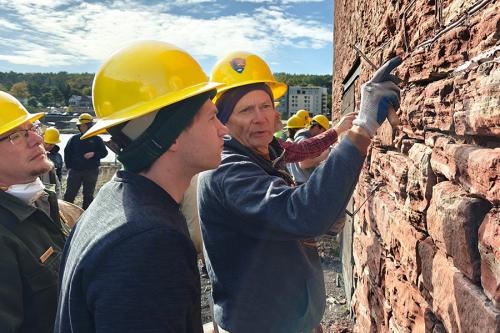
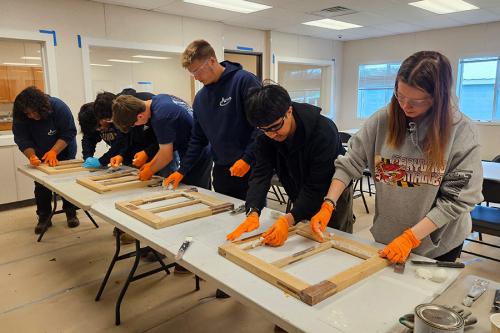
Students in a week-long masonry training made possible by The Campaign for Historic Trades, the National Park Service’s Historic Preservation Training Center, and the Keweenaw National Historical Park learn to repoint mortar from expert instructor Bruce Wright.
Photo by Kelly Pratt, The Campaign for Historic Trades
The Campaign for Historic Trades
“You don’t have to have a lot of experience. It’s about introducing people and getting people who are enthusiastic about preservation involved in this career field.”
—Emma Lucier-Keller, Traditional Trades Advancement Program internThe Campaign for Historic Trades is a dynamic workforce development initiative that works to expand and strengthen training and careers in the historic building trades. The campaign focuses on the skills needed to maintain, preserve, restore, and reconstruct historic structures in local communities. It seeks to develop statewide and national historic trades training opportunities, including partnering with the National Park Service’s Historic Preservation Training Center to promote and recruit for their Traditional Trades Advancement Program, which provides hands-on, historic preservation trade skills training to young people during an intensive twenty-week experience.
Staff members with The Campaign for Historic Trades provided Festival visitors with a wealth of information and guidance on training and career opportunities in the traditional building trades and historic preservation fields.
Participants
Natalie Henshaw, director of historic trades
Kelly Pratt, training coordinator
Jordan Riggs, recruitment and outreach manager
Nicholas Redding, president and CEO, Preservation Maryland
Laura Houston, Christiana Limniatis, Maggie Pelta-Pauls, Sam Schmidt, Preservation Maryland staff
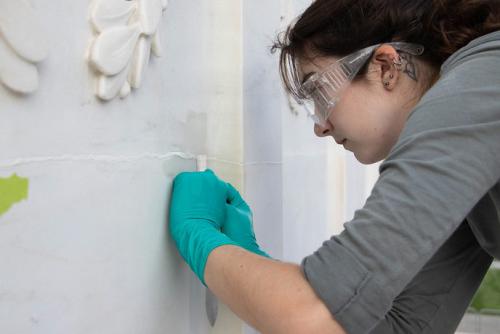

A National Park Service TTAP intern makes metal work repairs to a monument at Arlington National Cemetery in Washington, D.C.
Photo courtesy of U.S. Military / Smith
National Park Service Historic Preservation Training Center Traditional Trades Advancement Program
“TTAP was a fantastic experience for someone who wanted to get introduced to the preservation trades but didn’t really know where to start.”
—Ben Lammers, intern“You’re able to continue the craftsmanship of people who have been doing this way longer than you’ve been alive and continuing down that path for history.”
—Matt Jacobs, Director of Education & NPS-Mather High School Liaison, National Parks of New York HarborThe Historic Preservation Training Center’s Traditional Trades Advancement Program (TTAP) is committed to providing aspiring young preservationists—especially those who are underrepresented in the preservation trades—with a unique opportunity to work on important, real-world projects and learn how to preserve historic cultural resources in the nation’s national parks. The program gives experienced National Park Service preservation craft professionals the opportunity to pass on their craft skills, ensuring national park histories continue to inspire and educate the next generation. “We do whatever we can to save these structures for future generations to enjoy and learn about the rich history of the United States,” one HPTC master craftsman said.
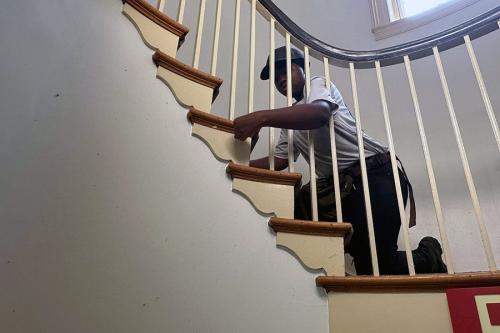
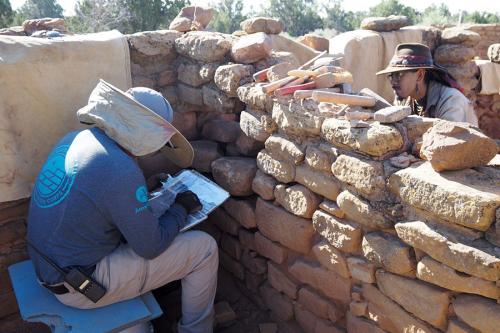
Expert craftspeople from the Historic Preservation Training Center in Frederick, Maryland, teamed up with TTAP interns and students from the Stephen T. Mather Building Arts & Craftsmanship High School in New York City to demonstrate traditional Appalachian-style log building, wood crafting, historic masonry, and wood color matching techniques.
Participants
Historic Preservation Training Center
Alyssa Fortune, exhibit specialist/project leader, wood-crafting section
Jessica Gordon, supervisory training specialist
John McCorrison, preservationist, wood-crafting section
Moss Rudley, director
Michael Turner, preservationist, carpentry section
Ricardo Diaz, staff
Ellee Banaszak, intern
Claire Schlick, internStephen T. Mather Building Arts & Craftsmanship High School
Omarion Thompson, student
Tyrone Vick, student&
Matthew Jacobs, director of preservation, education and youth engagement, National Parks of New York Harbor
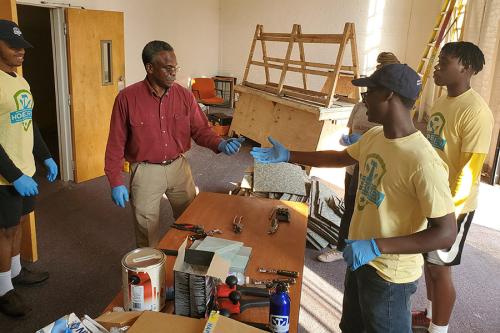
Historic window restoration expert Jim Turner shares his knowledge with students at a HOPE Crew preservation practicum at Tuskegee University in 2019.
Photo by Molly Baker, courtesy of the National Trust for Historic Preservation
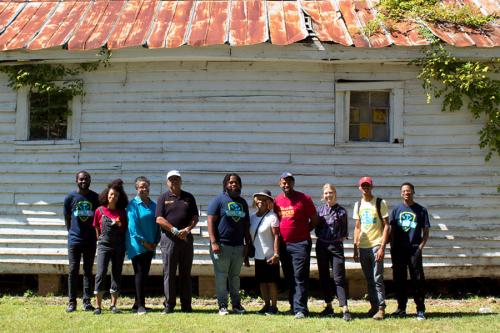
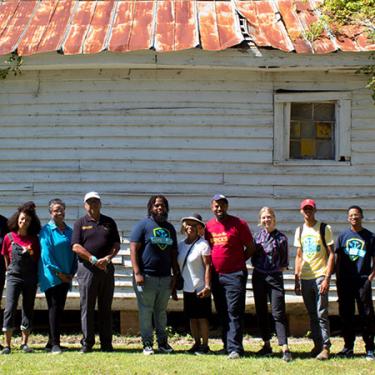
Jordan Lamar (center), a Tuskegee University architecture student, stands with community representative Ms. Dorthy Woody, the caretaker of Armstrong School, and members of the HOPE Crew Digital Documentation Fellowship team who contributed to the restoration of the historic school in Macon County, Alabama.
Photo courtesy of Jordan Lamar
National Trust for Historic Preservation HOPE Crew
“My project focused on the Armstrong School. What I liked most was having conversations with Ms. Dorthy Woody and listening to her oral histories. I loved learning from her. Hearing her stories connected me to the past.”
—Jordan Lamar, project participant, Tuskegee University“The thing that I always want to impart is the fact that opportunities don’t always come on the path where you’re looking. What is most important is being open to everything that comes, to explore every opportunity you can get to work with your hands and to learn something new.”
—Jim Turner, historic window restoration expert and mentorIn 2014, the National Trust for Historic Preservation launched HOPE Crew (Hands-On Preservation Experience), its trades training initiative, with the goal of bringing the preservation trades to a younger, more diverse audience. HOPE Crew links preservation projects to local youth organizations and communities across the nation. It brings the potential for thousands of youth participants to restore hundreds of historic sites, while learning preservation trade skills from master craftspeople. Since its inception, HOPE Crew has engaged over 3,700 volunteers, trained over 900 paid participants, and worked at over 200 sites.
At the Festival, participants shared their teaching and learning experiences and guided visitors through hands-on preservation training opportunities and information about historic preservation careers.
Participants
Molly Baker, program manager
Milan Jordan, director
Jordan Lamar, program participant
James A. Turner, mentor, wood and steel window restoration specialist
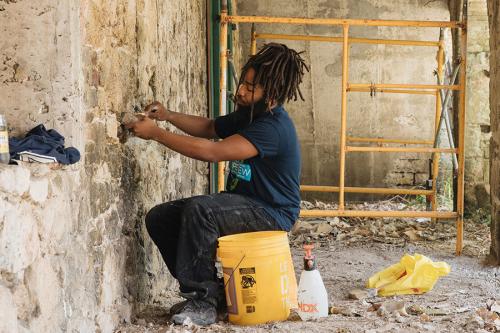
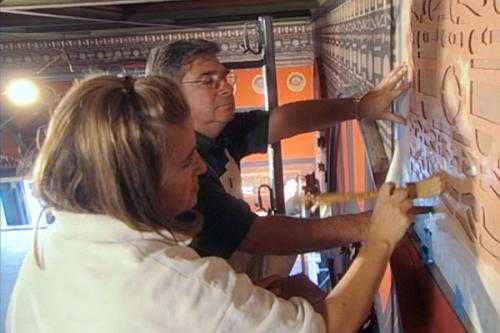
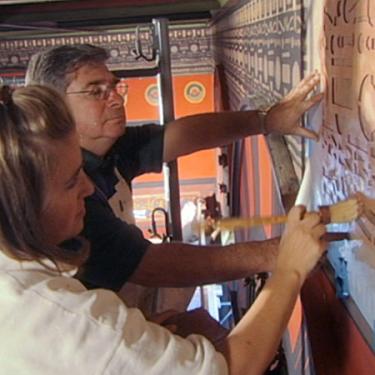
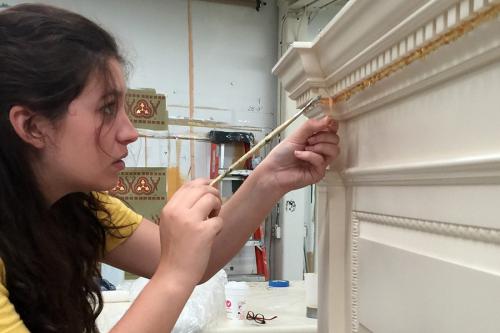
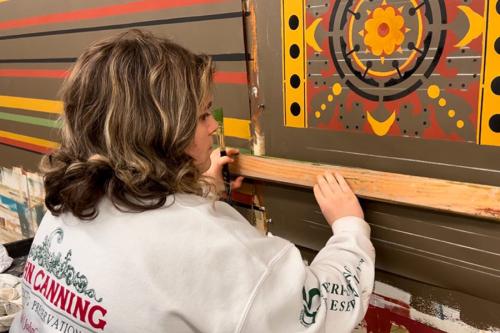
Master decorative painters John Canning and his daughter Jacqueline Canning Riccio use a stippling technique on hand-crafted stencils to restore decorative paint finishes dating to 1877 at historic Trinity Church in Boston.
Photo by Marjorie Hunt
John Canning & Co. Decorative Painting, Restoration and Preservation
“I love the research process. It’s like a treasure hunt. You have to search for answers.”
—Zoe Riccio, third-generation decorative painter“It’s like being an archeologist—pulling away layers of paint and discovering the original decoration and the wonderful craftsmanship of the past and then trying to replicate that.”
—John Canning, master decorative painterJohn Canning & Co. is a highly regarded preservation and restoration studio specializing in architectural arts, including decorative finishes, gilding, ornamental plaster restoration, and historic woodwork. First established in the early 1970s by John Canning, who learned his trade serving a rigorous apprenticeship as a church decorator in Glasgow, Scotland, before immigrating to the United States, John Canning & Co. has been a family-run business for over forty-five years. A master of decorative painting and a dedicated teacher, Canning has passed his craft skills on to his daughter Jacqueline Canning Riccio, his son-in-law David Riccio, and his granddaughters, Isabella and Zoe Riccio. The talented artisans at John Canning & Co. have restored many of our country’s most important historic buildings, including Grand Central Terminal, the U.S. Capitol Building, Radio City Music Hall, and the National Building Museum.
Three generations of the Canning-Riccio family taught Festival visitors about their decorative painting tools and techniques.
Participants
John Canning, decorative painter, founder, principal
David Riccio, decorative painter, principal
Isabella Riccio, conservation technician
Jacqueline Canning Riccio, decorative painter, studio design director
Zoe Riccio, production artist
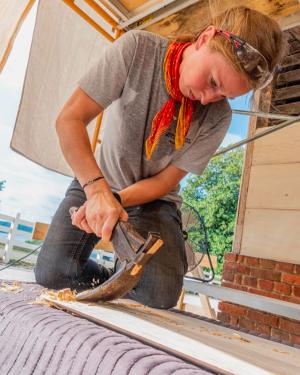
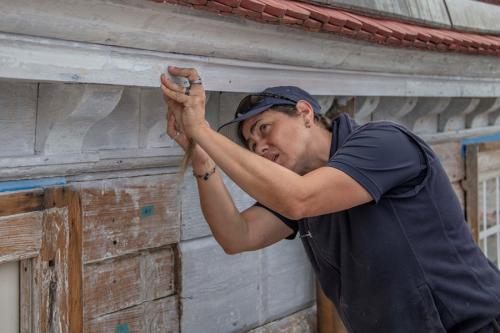
Linnea Carlson, a senior architectural carpentry student at the American College of the Building Arts, learned about eighteenth-century hand tools and techniques during her summer historic trades internship at Mount Vernon in 2024.
Photo courtesy of the Mount Vernon Ladies’ Association
George Washington’s Mount Vernon Preservation Trades Internship Program
“Having the opportunity to use a hand adze, hewing axe, hand planes, and chisels right alongside a power saw and other machine tools, all with the purpose of preserving one of America’s most iconic houses, was an experience which I will never forget.”
—Linnea Carlson, intern“There are young people out there who are gifted with their hands, and we need those people to take up the preservation trades.”
—Amy McAuley, restoration manager and master carpenterGeorge Washington’s Mount Vernon is committed to training the next generation of skilled artisans through its robust preservation trades internship program. Undergraduate students learn the philosophy and skills of preserving an historic eighteenth-century building through on-the-job experience, working side by side with master craftspeople, particularly in the areas of preservation carpentry, timber-frame construction, and heritage masonry.
Mount Vernon has embarked on a multiyear landmark preservation project from 2023 through 2026 to safeguard the mansion’s original building fabric, ensure its structural integrity, and preserve its important American story for generations to come. Skilled preservation artisans are playing a central role in this effort.
Participants
Allison Brashears, preservation carpenter
Brad Collins, preservation carpenter
Braden Crutchmer, preservation trades intern
Martin Dougherty, preservation trades intern
Steve Fancsali, preservation carpenter
Amy McAuley, restoration manager, preservation joiner
Thomas Reinhart, director of preservation
Pete Seroskie, preservation carpenter
Aaron Walker, preservation carpenter
Joe Zemp, preservation carpenter
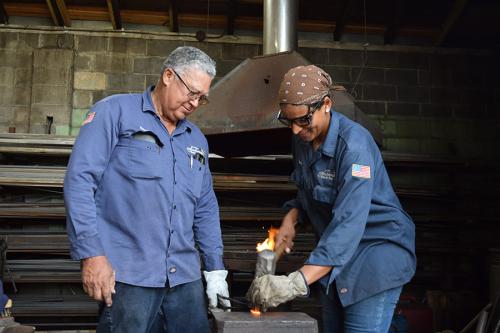
Master blacksmith Darryl Reeves and his apprentice Karina Roca work together at the anvil in Andrew’s Welding and Blacksmith Shop in New Orleans. “I’ve been training apprentices my whole career,” Reeves says. “The ones that want to learn, I train.”
Photo by Jonn Hankins, courtesy of New Orleans Master Crafts Guild
New Orleans Master Crafts Guild
“When I was thirteen my father told me, ‘If you want to learn how to plaster, then pick up them tools—come on!’”
—Wilfred Holmes, apprentice plasterer“To be a part of this endless loop, this intergenerational knowledge, it’s really a blessing.”
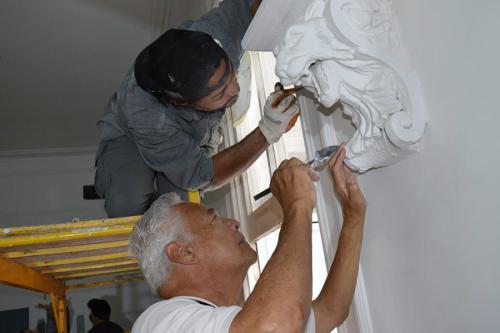
—Karina Roca, apprentice blacksmithThe New Orleans Master Crafts Guild seeks to revive the traditional building trades of New Orleans and provide apprenticeship training for new generations of master craftspeople to maintain and preserve the distinctive centuries-old architectural landscape of the city. Founding members Jonn Hankins, master plasterer Jeffrey Poree, and master blacksmith Darryl Reeves are dedicated to passing on their knowledge, skills, and cultural heritage to young people in New Orleans—“the kids in our community”—so that their treasured craft traditions can continue. “I love to see these young people get on in the craft. We want to keep the tradition alive,” says fifth-generation plasterer Poree.
At the Festival, Darryl Reeves and Jeff Poree joined with guild apprentices Karina Roca and Wilfred Holmes to demonstrate their blacksmithing and plastering skills while sharing their thoughts on why teaching and learning the traditional trades is important to them.
Participants
Jonn Hankins, founder, director
Wilfred Holmes, apprentice plasterer
Jeffrey Poree, master plasterer
John Poree, plasterer
Darryl A. Reeves, master blacksmith
Karina Roca, apprentice blacksmith

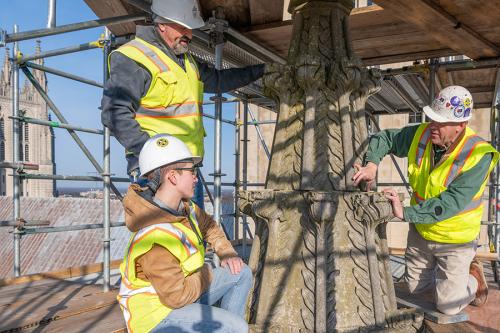
Head stone mason Joe Alonso shows an earthquake-damaged pinnacle to journeyman carver and mason Brianna Castelli and master carver Andy Uhl atop Washington National Cathedral.
Photo by Colin Winterbottom, courtesy of Washington National Cathedral
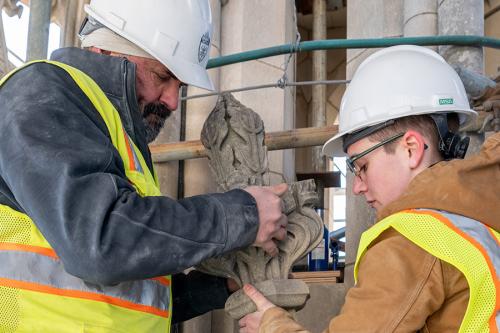
Master stone carver Andy Uhl and journeyman stone carver and mason Brianna Castelli lift a restored finial into place on Washington National Cathedral.
Photo by Colin Winterbottom, courtesy of Washington National Cathedral
Washington National Cathedral Earthquake Restoration Project
“I’m shaping and setting stones with skills passed down through the generations. The magnitude of it all constantly inspires me.”
—Brianna Castelli, journeyman stone carver and mason“Passing on our trade, our knowledge, to the next generation is so important. Brianna is part of it now. She’ll carry the craft forward.”
—Joe Alonso, head stone masonWashington National Cathedral, a magnificent fourteenth-century-Gothic-style cathedral in Washington, D.C., was severely damaged when a rare 5.8 magnitude earthquake struck the mid-Atlantic region in 2011. Since then, highly skilled craftspeople have worked tirelessly to restore the cathedral’s damaged stonework—its elaborately crafted pinnacles, gargoyles, crockets, and flying buttress—and to reinforce and protect the nearly 120-year-old national treasure against future damage.
Head stone mason Joe Alonso and master stone carvers Sean Callahan and Andy Uhl bring more than forty years of experience crafting and restoring the cathedral’s monumental stonework. At the Festival, they, and newly hired journeyman stone carver and mason Brianna Castelli, demonstrated their techniques for restoring damaged pinnacle stones, discussed the on-the-job training in preservation craftsmanship that takes place at the cathedral, and shared information about learning opportunities for young people interested in stone carving and heritage masonry. Master stone carver and letterer Nicholas Benson and his daughter Hope Benson demonstrated their skills creating beautiful inscriptional work.
Participants
Joe Alonso, head stone mason
Sean Callahan, stone carver and mason
Brianna Castelli, journeyman stone mason and carver
Andy Uhl, stone carver and masonThe John Stevens Shop
Hope Benson, stone carver and letterer
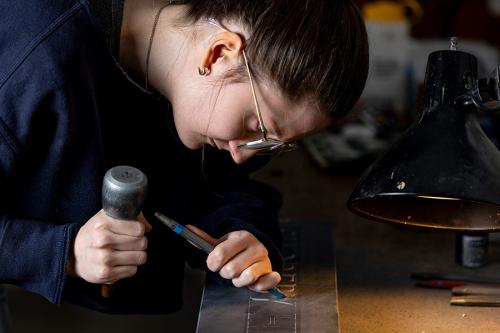
Nicholas Benson, stone carver and letterer
Guest Speakers
These visiting experts will participate in narrative sessions on the Festival’s Shop Talk stage.
Restoring the Smithsonian Castle
Carly Bond, associate director of architectural history and historic preservation, Smithsonian
Jamil Burnett, supervisory senior construction manager, Smithsonian
The Legacy of Spanish Stone Masons in Washington, D.C.
Jose Francisco Sieiro Bugallo, Ivan Sieiro Lopez, Manuel Seara, Lorton Stone
Victor Castro
Voices of Young Architects: Bridging the Design-Build Gap
Lucy Florenzo, Peyton Hoffman, Mary Bridget Jones, Connor Roop, architecture students, University of Notre Dame
Forging Connections: New Orleans Master Crafts Guild and Colonial Williamsburg
Madeleine Bolton, apprentice brickmaker, Colonial Williamsburg Foundation
Kenneth Schwarz, blacksmith, master of the shop, Colonial Williamsburg Foundation
Resource Guide
Sponsors