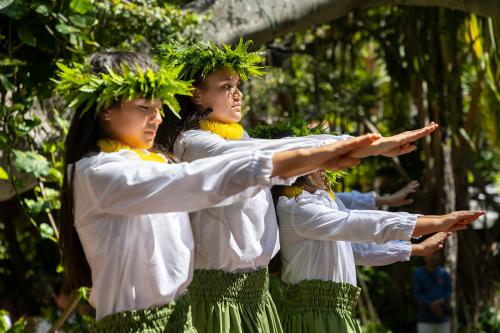
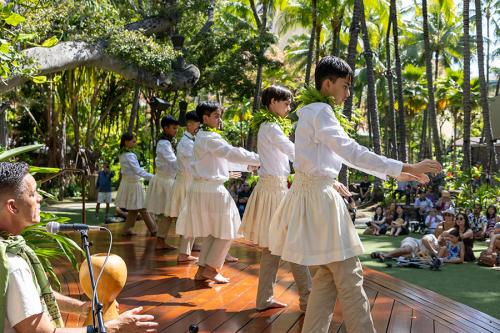
Members of Hālau I Ka Leo Ola O Nā Mamo perform at the 2024 Festival of Pacific Arts and Culture in Honolulu, Hawai‘i.
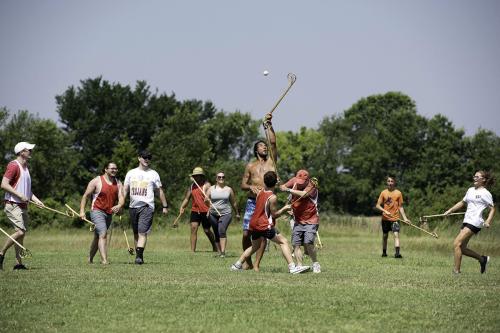
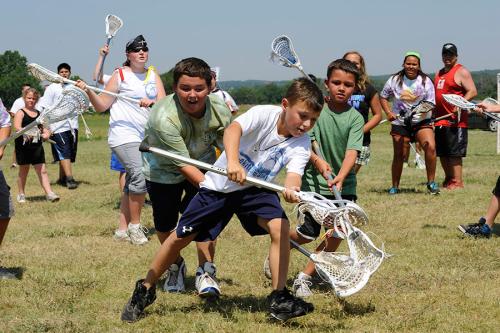
Myaamia community lacrosse game at the 2019 Annual Gathering of the Miami Nation in Miami, Oklahoma.
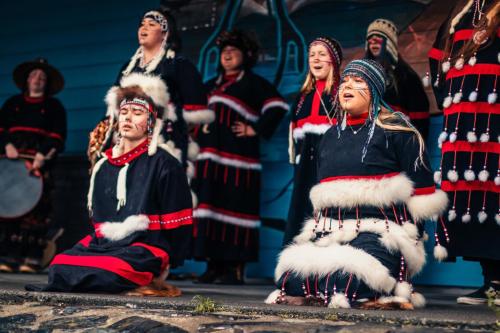
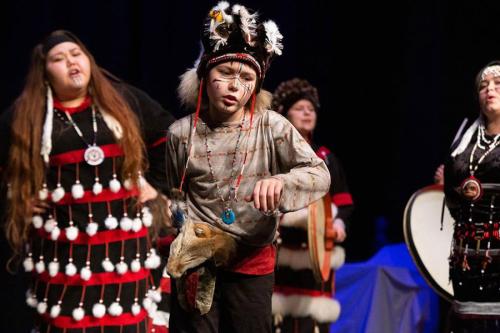
Kodiak Alutiiq Dancers perform at the 2024 Crab Fest in Kodiak, Alaska.
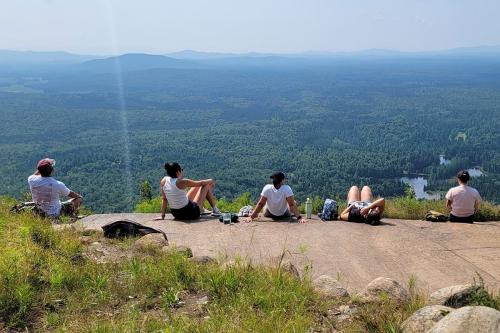
Members of Ionkwahronkha’onhátie’ rest after a hike in traditional Kanien’kéha (Mohawk) territory in upstate New York, 2024.
Native Language Reclamation in the U.S.
“We have been waiting for this generation.”
Language is a vital resource in the toolkit for young people shaping their future and the future of their peoples and communities.
When Europeans arrived in North America, Native communities north of the Rio Grande spoke at least 300 distinct languages. The languages are diverse, with 58 language families and 11 language isolates (with no known relatives). Yet, after hundreds of years of government policies and forced assimilation, they declined sharply in the twentieth century. With the Native American Languages Act in 1990, Native peoples began a movement to reclaim their languages, alongside connections to land, knowledge systems, and cultural heritage. While respecting the wisdom held by elders, young Native Americans, Alaska Natives, and Native Hawaiians have become the leading drivers for language reclamation.
At the Folklife Festival, the Native Language Reclamation in the U.S. program featured four groups representing different languages, regions, and ways of life and learning. Each will have engaging cultural demonstrations around what connects them to their cultures and motivates them to learn their languages. Visitors of all ages tried their hand at Myaamia ribbon work and lacrosse, learned Kodiak Alutiiq social dances, played Hawaiian ukulele tunes, learned from Mohawk basket makers, and more. Programming in the Gifts from the Land area highlighted their traditional foods and relationship to their environments.
In the central Language Lodge, learn about the beauty and resilience of Native languages. Each group had fun lessons where visitors learned how their languages sound and work, how new words for the modern world are made, and the ways these languages are used in new spaces. Participants shared heartfelt stories about how and why they learn their languages, and why it is important for them to become advocates and new speakers to ensure their languages are passed on to future generations.
Learn more about each group below and what they will be sharing at the Festival. Please join us on the National Mall to honor and celebrate youth and their involvement in the reclamation of Native languages.
Language Groups


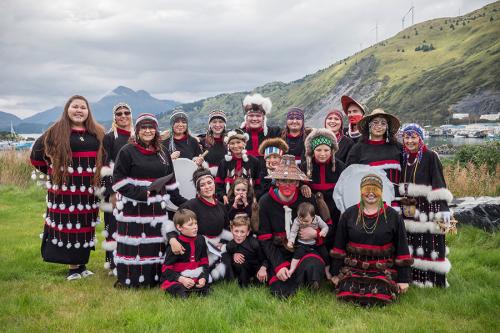
Members of the Kodiak Alutiiq Dancers gather for their thirty-year celebration.
Photo courtesy of Kodiak Alutiiq Dancers
Kodiak Alutiiq Dancers
The Language & Landscape
The Alutiiq or Sugpiaq people speak Sugt’stun, or simply Alutiiq. Some people also refer to the language as Alutiit’stun, which means “like an Alutiiq.” The language belongs to a group of related languages that covers a geographic area stretching from the Gulf of Alaska, west to the Aleutian Islands, and north to the Arctic Circle and into Canada and Greenland. The Alutiiq live on the large mountainous Kodiak Island in southwestern Alaska, on the Alaska Peninsula, and on the lower Kenai Peninsula. The bays and rivers in this region of Alaska are rich in fish and wildlife.
Russia colonized the Alutiiq/Sugpiaq in the eighteenth century. The first written Alutiiq was in the Cyrillic alphabet. After Alaska was purchased by the United States in 1867, boarding schools, orphanage schools, and public schools further eroded the language and traditional transmission of knowledge. Today there are a few elderly first-language speakers, but a growing number of younger speakers are taking the lead in revitalizing the language. Like most Native communities, they rely on Elder knowledge and are diverse in their approaches to motivating and encouraging language learning through camps, classes, online dictionary and curricula, and media, such as the encyclopedic audio Alutiiq Word of the Week. Many Alutiiq youth get interested in the language through traditional arts, music, and especially dance.
Participants
The Kodiak Alutiiq Dancers were formed in 1987. They continue to learn and share their Alutiiq/Sugpiaq ancestral heritage and increase pride through reawakening their dance traditions. The Alutiiq/Sugpiaq people have always danced as a community to perform rituals and ceremony, to share stories, and to entertain each other. Today, the group honors their ancestors by dancing their stories and living their culture.
The Kodiak Alutiiq Dancers performed at the main stage and in the Potomoc Atrium at the National Museum of the American Indian. They also held dance workshops where visitors could try Alutiiq social dances. Visitors watched and participated in Kakangaq, a traditional game to hone hunting skills, where players toss disks at a target on a seal hide. In the group’s tent, visitors saw salve making and headdress beading while learning about Alutiiq dress and regalia.
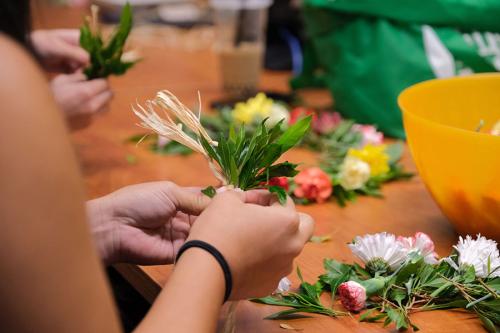
ant) and hula (dance).
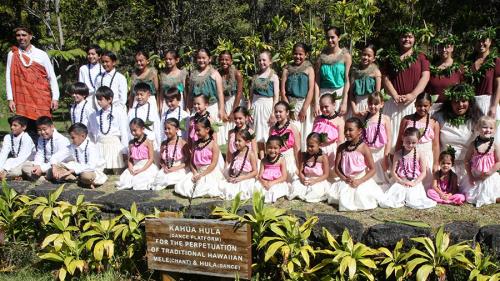
Hālau I Ka Leo Ola O Nā Mamo pose after their performance at the hula platform at Kaʻauea in Hawaiʻi Volcanoes National Park.
Photo by Kenji Kuroshima, courtesy of Volcano Art Center’s, Hula Arts at Kīlauea Program
Hālau I Ka Leo Ola O Nā Mamo
The Language & Landscape
Ka ʻōlelo Hawaiʻi (the Hawaiian language) is part of the Austronesian language family. It shares similarities with other languages spoken in Polynesia, such as Māori and Tahitian. Before airplanes, travel by canoe was common in the Hawaiian archipelago and facilitated trade, communication, and migration, yet dialects emerged on different islands over time. Dialects on the islands of Niʻihau and Kauaʻi are considered older than those on islands further east (Oʻahu, Molokaʻi, Lānaʻi, Maui, Hawaiʻi).
In response to the decline of ʻōlelo Hawaiʻi speakers, a group of teachers met in 1983 to discuss ways to perpetuate the language. This meeting resulted in the establishment of the ʻAha Pūnana Leo (language nest) immersion preschools. To continue their education in the language, full-immersion K-12 public schools grew across the islands. Today, youth can get a BA, MA, and PhD in ka ʻōlelo Hawaiʻi at Ka Haka ʻUla O Keʻelikōlani (College of Hawaiian Language, University of Hawaiʻi at Hilo). The Hawaiian immersion programs are an international model for language and cultural reclamation.
Participants
Hālau I Ka Leo Ola O Nā Mamo (School of the Living Voice of the Descendants) is a hula school from the island of Hawaiʻi. The students grew up in Pūnana Leo nests and are either current students or alumni of immersion schools. Kumu hula (teachers) Pelehonuamea (Pele) and Kekoa Harman have dedicated their lives to the Hawaiian revitalization movement. Uniquely, Hālau I Ka Leo Ola O Nā Mamo teaches hula exclusively through ka ʻōlelo Hawaiʻi. The hālau embraces Kumu Honua Mauli Ola, a core philosophy to cultivate mauli Hawaiʻi, the unique life force of each Hawaiian person, through ʻōlelo (language), pili ʻuhane (spirituality), lawena (behavior, mannerisms), and ʻike kuʻuna (traditional knowledge).
Pele is the great-granddaughter of the late Hawaiian scholar Mary Kawena Pukui, who was honored with a $1 coin through the U.S. Mint in 2025. Pukui’s legacy continues to inform the development of resources and materials for Hawaiian immersion classrooms.
At the Festival, Hālau I Ka Leo Ola O Nā Mamo offered a variety of hula demonstrations on the main stage celebrating some of Pukui’s original compositions. Full-length hula performances took place in the Potomac Atrium at the National Museum of the American Indian. Hālau I Ka Leo Ola O Nā Mamo will also hold introductory workshops on various traditional instruments and ukulele playing. To top it off, some of the youth cooked easy Hawaiian delicacies in the Foodways kitchen.
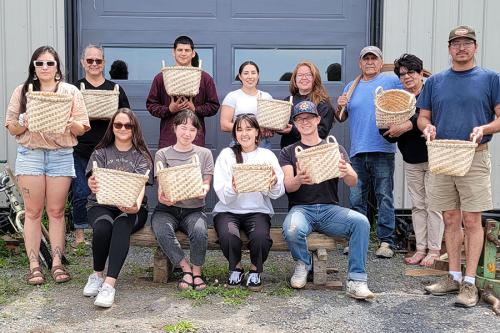
First and second language speaking participants pose with their new black ash corn washing baskets they learned to make as a part of the Community Workshops series. All Ionkwahronkha’onhátie’ activities are conducted fully in Kanien’kéha (the Mohawk language).
Photo by Taiawentón:ti’ Chelsea Sunday
Ionkwahronkha’onhátie’
The Language & Landscape
Kanien’kéha (Mohawk) is an Iroquoian language spoken by Kanienʼkehá:ka (Mohawk) people. The Kanienʼkehá:ka are part of the Haudenosaunee Confederacy (Six Nations) of Iroquoian speaking peoples. The Ahkwesáhsne Mohawk Territory is one of eight Kanienʼkehá:ka communities, each with their own dialect. Their territory is the northern woodlands and streams on both banks of the St. Lawrence River, straddling the international border between New York State and the Canadian provinces of Ontario and Quebec, with traditional territories stretching down through the Mohawk Valley.
The Akwesasne Freedom School was started during the bilingual education surge of the 1970s and is one of the longest-running Native language schools. Some of the Ionkwahronkha’onhátie’ participants graduated from this school.
Participants
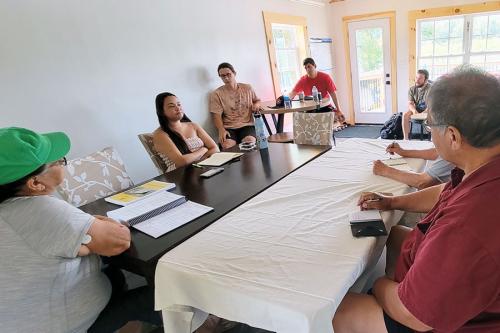
Ionkwahronkha’onhátie’ (We are becoming fluent) is a grassroots organization operated by and for young adult second-language (L2) learners of Kanien’kéha working to reclaim and revitalize their language. Within the larger language revitalization efforts underway across Kanien’kehá:ka communities, they focus on supporting L2 learners as emerging speakers, parents, and leaders, who are crucial to re-establishing intergenerational language transmission and taking Kanien’kéha into the future. Together they are investing in speakers, developing a well-connected speaker community, and creating spaces for language use between and across generations.
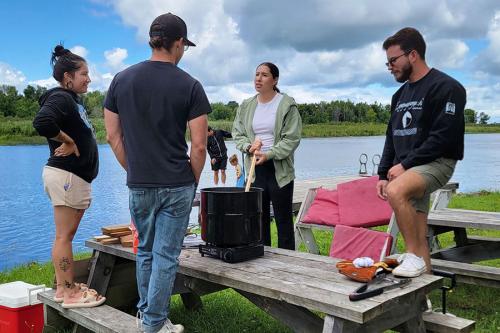
At the Festival, members of Ionkwahronkha’onhátie’ demonstrated Kanienʼkehá:ka ash basket making and fingerweaving. They also made a traditional clay pot in which they cooked a traditional white corn dish. They offered cooking demonstration in the Festival Foodways kitchen and talked about their Iethiiehià:rons “we raise them” initiative in the Gifts from the Land area.

Myaamia graduates with the class of 2024 at Miami University of Ohio pose in their graduation stoles featuring traditional ribbon work and writing in the Myaamia language.
Photo by Karen Baldwin, Miami Tribe of Oklahoma
Myaamia Center
The Language & Landscape
Myaamiaataweenki (the Miami-Illinois language) is an Algonquian language originally spoken in the lush woodlands of the lower Great Lakes, today known as Indiana, Ohio, and Illinois. Surviving extreme reductions in lands and two forced removals, Myaamiaki (Miami people) are scattered across the United States, with the Tribal Nation, the Miami Tribe of Oklahoma, located in the northeast corner of Oklahoma.
The last fluent first-language speaker of Myaamiaataweenki died in the middle of the twentieth century, and the language became silent. But in the 1990s, Myaamia citizen Daryl Baldwin and linguist David Costa began researching and reconstructing the language through archival manuscripts. Baldwin and his wife began learning the Myaamia language and home-teaching it to their children. The Miami Tribe began holding a summer camp for youth to reconnect with their Myaamia heritage and language in 2005 and, by doing so, began to reestablish community and extended kinship bonds.
Reviving a silent language through archival records and the slow but continuous work of building community participation is known as the Breath of Life approach. Within the Myaamia community, this process is known as Myaamia Eemamwiciki (Miami Awakening).
Participants
Located within the Myaamia homeland, Miami University, in Oxford, Ohio, is home to the Myaamia Center, an intentional research and education collaboration between the Miami Tribe and the university. Myaamia youth attending Miami University have the unique experience of joining a small community of Myaamia students to learn about their history, culture, and kinship. Myaamia students graduate from all fields with a deeper understanding and appreciation of what it means to say niila myaamia—“I am Miami.” Students who participated in the Myaamia Heritage Program have a ninety percent graduation rate.
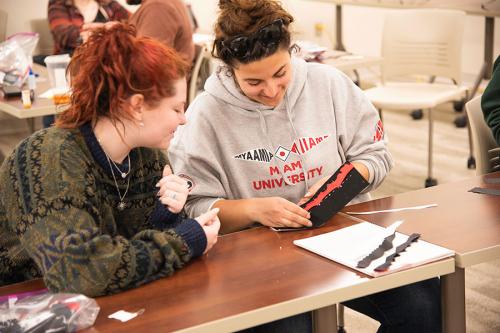
At the Festival, Myaamia Heritage Program students demonstrated peekitahaminki (lacrosse) and showed how they make their traditional peekitahaminki sticks. Students demonstrated their new skills in peepankišaapiikahkia eehhkwaatamenki (ribbon work), a traditional craft that emerged in the late 1700s when Myaamia people traded with Europeans for silk ribbons. Using strips of silk, Myaamia women made intricate geometric patterns, which are extensions of geometric patterns seen in earlier artforms. While peepankišaapiikahkia used to be passed down through families, young Myaamia women and men are learning the skill in workshops and evening gatherings.
Visitors also learned more about their language, the heritage classes at Miami University, their lunar calendar, and traditional food gathering and cultivation.